Claude Code cost problems rarely begin with a scary invoice.
They begin with a harmless-looking task: “clean up this service”, “make the tests better”, “see why this is slow”. The agent starts reading. Then it searches. Then it opens adjacent files, re-runs commands, checks a second theory, changes direction, and by the time you look back the useful work is mixed with a pile of exploration you would never have approved if a junior engineer had asked for it out loud.
That is the trap. Agent cost is not only a model pricing issue. It is often a workflow bug.

The expensive part is often the wandering
Claude Code is useful because it can explore a repo, hold context, call tools, and make changes. The same strengths can turn expensive when the task boundary is lazy.
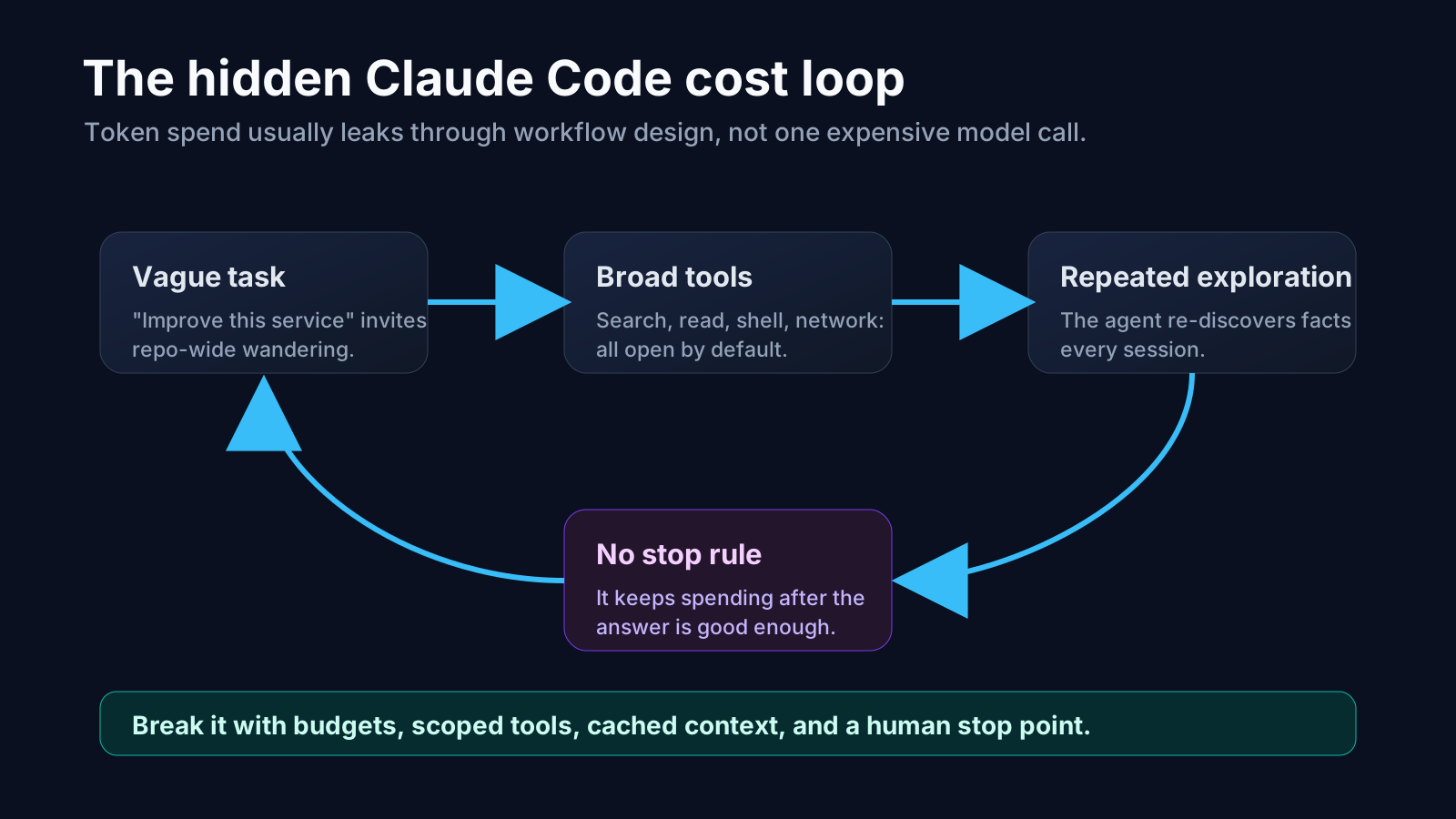
A vague task gives the agent permission to invent scope. Wide tool access lets it inspect too much. Missing context means it rediscovers facts the team already knows. No stop rule means it keeps working past the point where a human would have paused and asked, “Is this enough?”
You do not fix that with a cheaper model alone. A cheaper model can still waste time in a badly shaped workflow.
The better question is: what did we allow the agent to spend attention on?
Put a budget in the task, not just the dashboard
Most teams notice cost after the run. That is too late for the run that already happened.
Give Claude Code a budget before it starts:
- maximum files to inspect before reporting back
- directories that are in scope and out of scope
- commands it may run without approval
- when it should stop and ask for a decision
- what evidence counts as “done”
This does not need to be bureaucratic. Even a short boundary helps:
Task: find the cause of the failing checkout validation test.
Scope: api/checkout/** and tests/checkout/** only.
Budget: inspect up to 8 files, run one targeted test command, then report the likely fix before editing.
Stop if: the issue appears to require payment provider changes or database migration edits.
That prompt is not glamorous. Good. It is cheaper than letting an agent tour the whole codebase because the task said “investigate checkout”.
Cache the boring context
One of the quiet ways teams burn money is asking agents to rediscover the same operating facts every day.
Where are the generated files? Which tests are slow? Which package scripts are safe? Which folders contain legacy code nobody should modernize during a bug fix? Which deploy files require human review?
If Claude Code has to learn those facts from scratch in every session, you are paying for repeat archaeology.
Keep a small project brief and feed it into the workflow. Not a 40-page internal wiki dump. A sharp operating note:
- repo map
- safe commands
- blocked paths
- known slow tests
- service ownership
- review rules
- rollback expectations
This is where the cost conversation touches permissions. The same notes that save tokens also reduce blast radius. If a workflow says “do not edit generated clients” and the file tool cannot write there anyway, you have saved money and lowered risk.
Related: I wrote about this from the safety side in Claude Code permissions: the production mistake that bites later.
Stop successful runs sooner
There is a strange failure mode with capable agents: they keep being helpful.
The first fix is good. Then the agent adds cleanup. Then it notices a naming issue. Then it updates a nearby test. Now the diff is larger, review is slower, and nobody is quite sure which change mattered.
For production work, a good Claude Code run should often stop earlier than the model wants to.
A useful stop rule sounds like this:
When the failing test passes and no unrelated files changed, stop. Summarize the fix, the command evidence, and the rollback path. Do not do cleanup unless asked.
That one line protects cost, review quality, and trust. It also makes evals easier because the expected behavior is narrower. If you are collecting failed runs for evaluation, as I suggested in Claude Code evals should start with bad runs, add cost behavior to the case. Did the agent stay within the file budget? Did it stop after the test evidence was good enough? Did it avoid decorative cleanup?
Watch for cost loops in code review
You can often see the cost problem in the final diff.
A healthy agent run has a clean line from task to evidence: problem, small change, test result, rollback path. An expensive run feels wider than the request. It touches files that were not part of the job. It includes drive-by refactors. The summary says “also improved” too many times.
When I review agent-assisted work, I would rather ask a blunt question than admire the cleverness:
Which part of this diff paid rent?
If nobody can answer, the workflow is teaching the agent the wrong habit.
Treat cost as production telemetry
Do not wait for finance to become your observability system.
Track the basics per run:
| Signal | Why it matters |
|---|---|
| Task type | Bug fix, test repair, refactor, documentation, migration |
| Files inspected | Shows exploration width |
| Files changed | Shows diff size and review load |
| Tool calls | Reveals loops and repeated commands |
| Test commands run | Separates useful verification from noise |
| Human interrupts | Shows where the workflow needs better gates |
| Outcome | Merged, rejected, reworked, rolled back |
You do not need a fancy dashboard on day one. A simple run log is enough to spot bad patterns: one workflow keeps scanning the repo, one prompt creates large diffs, one tool permission invites expensive detours.
Then change the workflow. Narrow the scope. Add cached context. Split the task. Put approval before the expensive tool. Move a high-risk path behind human review.
Related: the Claude Code review packet I want before approving agent work because cost and retries belong in the review evidence, not in a billing surprise later.
The real goal is earned autonomy
The point is not to make Claude Code timid. The point is to make autonomy something the workflow earns.
Start with small budgets and tight scope. Measure whether the agent gets the job done without wandering. Widen the boundary only after the run history shows it can stay inside the current one.
That is a much better posture than “we will watch the bill”. By the time the bill tells you something, the agent has already practiced the wrong behavior.
If you are building this into team workflows, start with the free Claude Code production checklist. It covers the operating controls I would want in place before a team starts widening autonomy.
I'm writing the practical field guide for this.
Claude Code: Building Production Agents That Actually Scale is about the system around the agent: permissions, MCP boundaries, evals, observability, cost controls, rollback, and human review.
Read the Amazon Kindle edition or start from the book landing page.