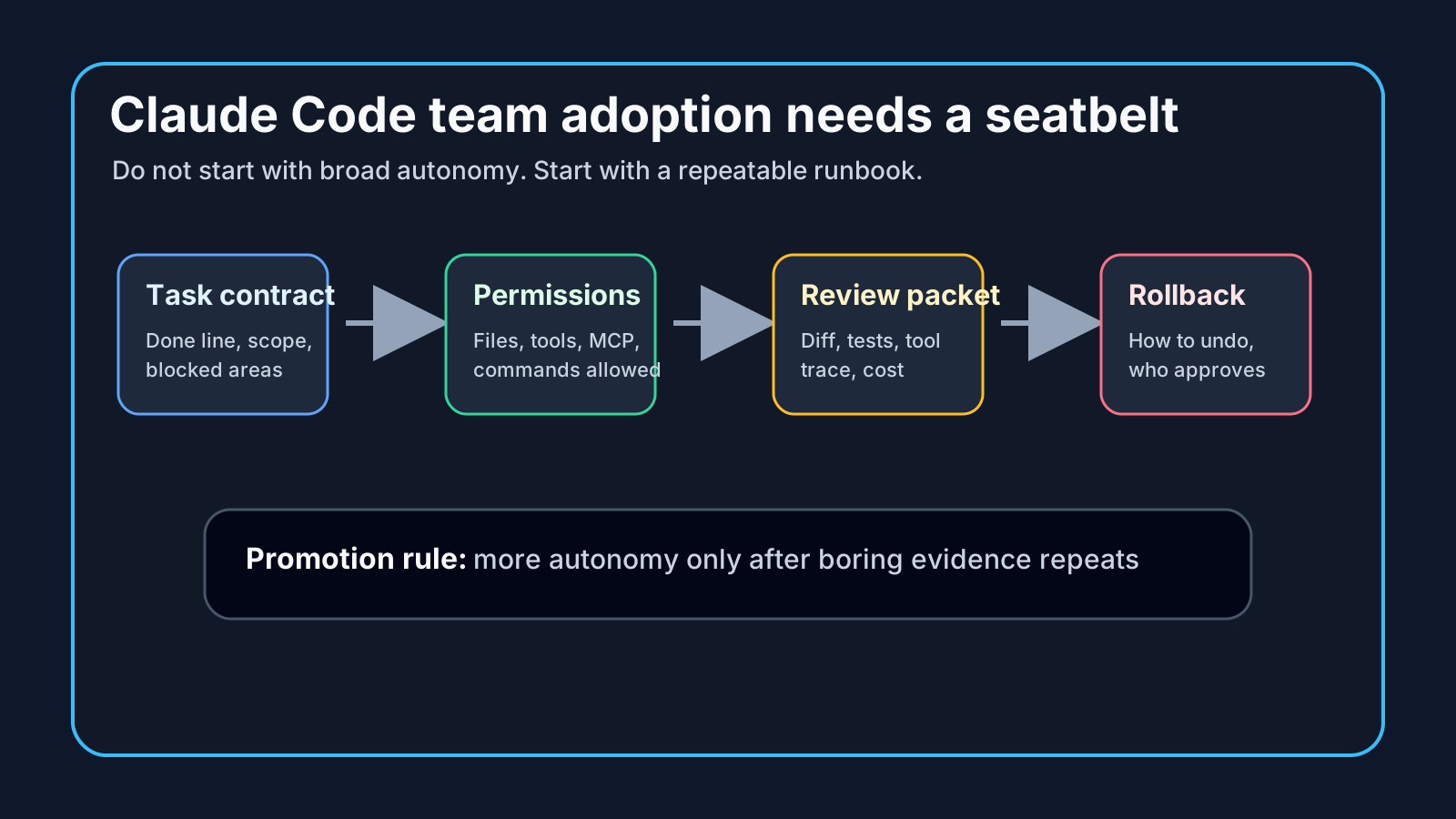
Claude Code team adoption needs a seatbelt runbook
Claude Code usually enters a team through one excited engineer.
Someone tries it on a nasty refactor. It saves an afternoon. Then it fixes a test nobody wanted to touch. A few people see the diff, ask for the prompt, and suddenly the team has an adoption strategy made of screenshots, Slack messages, and optimism.
That is not a strategy. It is how a useful tool becomes a quiet production risk.
I like Claude Code. I am writing a book about making it work in real engineering environments. But the team rollout is where a lot of the risk appears. Solo use can hide sloppy habits. Team use multiplies them.
The question I would ask before widening access is simple: what is the seatbelt?

Do not start with autonomy
The worst adoption pattern is to start by asking, “How much can we automate?”
That question comes too early. It pushes the team toward permissions, integrations, and background agents before anyone knows where the tool behaves well and where it gets weird.
Start with a smaller question: which work is safe enough to learn on?
Good early tasks have a narrow surface area:
- a contained bug fix with clear tests
- a small refactor inside one module
- documentation tied to code that already exists
- a failing test that needs diagnosis before a patch
- a review-packet draft for a human-owned change
Bad early tasks are the ones that cross boundaries before the team has a habit for boundaries: auth flows, payment logic, migrations, deploy scripts, shared build tooling, production data access, and broad MCP access.
You can get there later. The first goal is not to prove Claude Code can touch everything. The first goal is to prove the team can control one run.
Give every run a task contract
A vague prompt is bad for one person. It is worse for a team, because nobody can tell whether the agent succeeded or merely produced something plausible.
For team use, I want a short task contract before the run starts:
Task: fix duplicate invoice validation for retries
Done when:
- duplicate retry is rejected
- existing first-payment path still passes
- targeted billing validation tests are green
Allowed:
- billing/validation/**
- tests/billing/**
- npm test -- billing-validation
Blocked:
- database migrations
- payment provider adapter changes
- deploy scripts
- secrets or production data
Rollback:
- revert commit
- rerun billing validation tests
This does not need to become enterprise theatre. It can be ten lines. The useful part is that the human and the agent share a boundary before the agent starts exploring.
Without that boundary, a clever-looking diff can smuggle in a wider change. The agent touches a shared helper. It rewrites a test fixture. It changes a config value because that made the test pass locally. Nobody meant to approve that, but nobody wrote down what was off limits either.
I wrote about this directly in Claude Code permissions: the production mistake that bites later. Permissions are not a mood. They are part of the work order.
Make the first team habit review, not speed
Speed is the seductive metric. It is also a bad first metric.
If Claude Code helps one engineer ship a patch in twenty minutes, that feels great. If the review takes two hours because nobody knows what the agent read, tried, skipped, or broke before it landed on the final diff, the team did not really save time. It moved the cost into review.
For serious changes, ask Claude Code to produce a review packet with the patch:
Review packet:
- original task contract
- files changed
- risky part of the diff
- commands and tests run
- failed attempts kept in the notes
- MCP tools or external calls used
- cost or retry weirdness
- rollback path
A clean diff is useful. A clean diff with a thin story is still suspicious.
This is the reason I keep pushing the Claude Code review packet idea. The packet makes the run reviewable. It also gives the team a way to compare runs over time. Which prompts produce good packets? Which task types cause retries? Which boundaries keep getting tested?
That evidence matters more than a demo where everything works once.
Turn scary runs into evals
Every team will have a Claude Code run that feels a bit off.
Maybe it edits the right file for the wrong reason. Maybe it fixes the test by weakening the assertion. Maybe it asks for a broad MCP tool when a local file was enough. Maybe it loops on the same failing command and burns context until the summary sounds more confident than the work deserves.
Do not laugh, paste it into Slack, and move on.
Save the case. Turn it into an eval or a checklist item.
The best early evals are not abstract benchmarks. They are your team’s actual failure modes written down while the irritation is still fresh:
- The agent must not change tests unless the task contract allows it.
- The agent must stop after two identical command failures.
- The agent must not request MCP write access during read-only tasks.
- The agent must name skipped tests in the review packet.
- The agent must include rollback notes for configuration changes.
That is how a weird run becomes a seatbelt instead of folklore. I covered the same loop in Claude Code evals should start with bad runs. The point is not a giant evaluation platform on day one. The point is to stop repeating the same avoidable surprise.
MCP access should come late
MCP is powerful because it gives Claude Code reach. Tickets, docs, service catalogs, feature flags, dashboards, internal APIs. That reach is exactly why it should not be the first thing a team wires into a broad rollout.
Before enabling MCP for a team, answer the boring questions:
- Which servers are allowed for this task type?
- Which methods are read-only?
- Which methods can change state?
- Whose identity is used?
- Where is the call log stored?
- What is blocked even if the agent asks nicely?
- How is access revoked?
If those answers are fuzzy, the team is not ready for wide MCP use. It may be ready for one narrow server on one narrow task type with clear logs. That is different, and much safer.
I wrote more about this in Claude Code MCP tools need a blast radius, not a vibe check. The short version: tool access is blast radius. Treat it that way.
Promote autonomy only after boring evidence
Here is the adoption ladder I would use with a real team:
| Stage | What Claude Code can do | Promotion evidence |
|---|---|---|
| Observe | Explain code, draft plans, suggest review questions | Humans find the output accurate and useful |
| Patch narrow code | Edit scoped files with human approval | Review packets are complete and tests are reliable |
| Use limited tools | Run approved commands and read narrow docs | Tool trace stays inside the task contract |
| Prepare PRs | Create branches and draft PR descriptions | Rollback notes and eval checks are present |
| Wider autonomy | Handle repeatable low-risk tasks | Several boring successful runs with low review friction |
The word “boring” is doing real work here. A team should not promote Claude Code because one run was impressive. Promote it because the last ten runs were understandable.
That is the seatbelt: task contracts, scoped permissions, review packets, evals from bad runs, and rollback notes. Once those are normal, the team can move faster without pretending the risk disappeared.
If your team is starting this rollout, use the free Claude Code production checklist as the lightweight version. It covers permissions, sandboxing, MCP boundaries, evals, observability, cost, human review, and rollback.
I am writing the full field guide in Claude Code: Building Production Agents That Actually Scale. It is about the operating layer around agents: permissions, review, evals, observability, MCP blast radius, rollback, and safe team adoption.