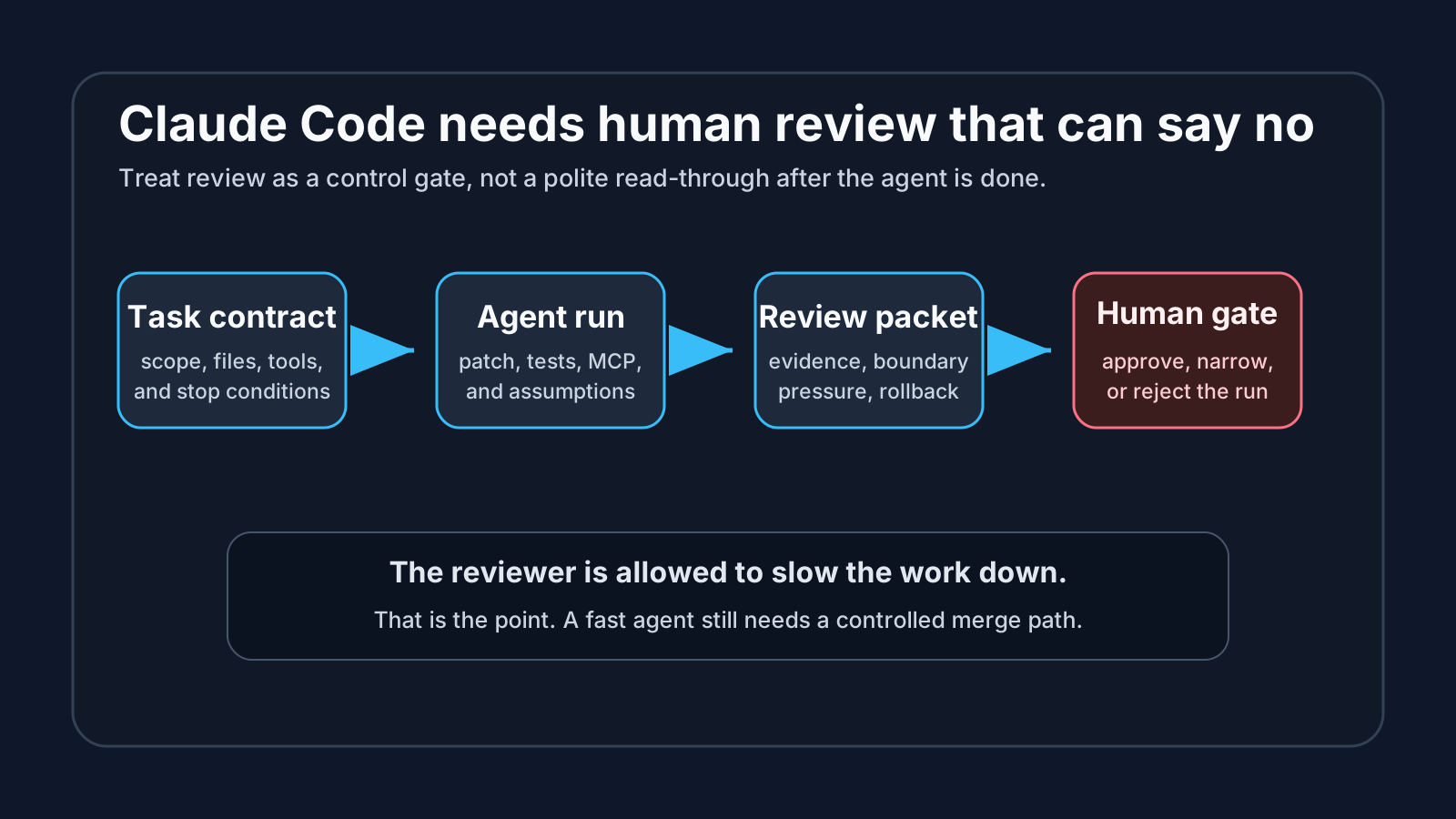
Claude Code human review is a control, not a vibe check
Claude Code can make a risky change look surprisingly calm.
The diff is tidy. The tests pass. The summary sounds measured. It may even say the change is low risk, which is exactly the sentence that should make a reviewer sit up a bit straighter.
Human review is where the team decides whether that confidence is earned. If review is only a quick skim after the agent has finished, it is not a control. It is ceremony.
For production-adjacent work, I want human review to have teeth. The reviewer must be allowed to slow the work down, send Claude Code back into a narrower task, ask for better evidence, or reject the run completely.

That can feel awkward because the agent has already done useful work. Nobody wants to be the person blocking a clean patch. But the point of a human gate is not to admire the patch. It is to decide whether the run was controlled enough to merge.
Review starts before the prompt
A lot of teams treat human review as the final step. Claude Code gets a task, works through the repo, produces a patch, and then a human reads the output.
That is too late for serious work.
Review starts when the task contract is written. Before the run begins, the human should decide what the agent is allowed to touch, what evidence it must produce, and what should make it stop.
For example:
Task: fix duplicate invoice export rows for EU accounts.
Allowed reads: exporter code, exporter tests, ticket PAY-2184.
Allowed edits: exporter code and tests only.
Allowed commands: targeted unit tests and lint.
Stop before: billing config, production data, migrations, deploy tools,
customer records, or write-capable MCP tools.
Review evidence required: failing test before fix, passing test after fix,
files inspected, assumptions, and rollback note.
This is not paperwork for its own sake. It gives the reviewer something to compare against later.
Did Claude Code stay inside the contract? Did the task quietly expand? Did the agent need a tool that was not part of the original plan? Did the evidence actually prove the change, or did it only prove the narrow case the agent happened to test?
Without the contract, review becomes vibes. The reviewer is left asking, “Does this look okay?” That is not enough near money, permissions, customer data, deployment paths, or operational workflows.
The reviewer should inspect the run, not only the diff
A final diff hides the path that created it. That is true for human engineers too, but agents make the gap wider.
Claude Code may read files the reviewer never sees. It may try three failed approaches before the final one. It may infer behaviour from ticket comments, logs, docs, or MCP tools. It may hit a permission boundary and then work around it in a way that looks clever but changes the risk profile.
So the review packet should be part of the deliverable, not an optional note.
For a serious Claude Code run, ask for this:
Scope used: what files, tools, tickets, docs, and commands were consulted.
Patch summary: what changed and why.
Evidence: tests, checks, and reproduction notes.
Boundary pressure: what the agent wanted but did not have.
Assumptions: what it inferred rather than proved.
Residual risk: what still needs human judgement.
Rollback: how to undo or contain the change if it behaves badly.
The two uncomfortable fields are usually the most useful: boundary pressure and assumptions.
If Claude Code wanted production-like data but did not have it, the reviewer needs to know. If it assumed an old account shape cannot happen anymore, the reviewer needs to know that too. Those notes are where a polished patch becomes reviewable engineering work.
A good reviewer can say no
This is the part teams under-design.
If every Claude Code review ends in “looks good”, people learn that the human gate is decorative. The agent gets more trust than the workflow has earned.
A useful review gate has several possible outcomes:
- Approve the change because the run stayed in scope and the evidence is strong.
- Ask Claude Code for a narrower follow-up because the first task grew too wide.
- Request more evidence because the tests do not prove the risky behaviour.
- Split the work because the patch mixes safe cleanup with a production-sensitive change.
- Reject the run because it crossed a boundary or relied on hidden context.
That last outcome matters. Not because reviewers should be hostile to agents. Because the system needs a real brake.
In financial-services engineering, the best controls are the boring ones people sometimes complain about. They interrupt the shortcut that feels reasonable under pressure. Claude Code needs the same kind of discipline when it gets close to production systems.
Watch for social pressure from a clean patch
There is a subtle pressure in agent-assisted work: the patch arrives already packaged.
It has a summary. It has tests. It has a confident tone. It looks like someone has already done the thinking.
That can make human reviewers less willing to ask basic questions:
What did we prove?
What did we not prove?
What was out of scope?
What would we do if this breaks tonight?
Who owns the decision to merge this?
Those questions are not anti-agent. They are the point of using an agent responsibly.
A strong Claude Code workflow should make the reviewer feel more informed, not more pressured. The agent can draft the evidence, but the human still owns the decision.
Make review visible enough to improve
The review gate should leave a small trace. Not a giant audit system. Just enough to learn from repeated runs.
Track the patterns:
- Which tasks often need wider MCP access?
- Which prompts produce weak evidence?
- Which reviewers keep finding missing rollback notes?
- Which areas of the codebase create repeated boundary pressure?
- Which tests are too shallow for agent-generated patches?
After a month, those notes become useful. They show where the team can safely widen Claude Code and where it should stay constrained. They also show where the codebase itself is hard to review.
That is the better promise of agentic coding. Not “the agent writes code and humans approve faster”. More like: the agent does useful work, and the team gets sharper about scope, evidence, and risk.
Start with one rule
If you want a simple starting point, use this rule for the next production-adjacent Claude Code task:
The reviewer must be able to reject the run based on missing evidence,
boundary pressure, unresolved assumptions, or an unrealistic rollback note.
Put that rule in the prompt. Put it in the pull request template. Say it out loud when the team starts using Claude Code for anything near production.
It changes the mood of the workflow in a good way. The goal is no longer to get a neat patch from the agent. The goal is to get a controlled change that a human can responsibly merge.
The free Claude Code production checklist includes this review gate alongside permissions, MCP blast radius, evals, observability, and rollback.
For the full operating model, I wrote the Claude Code book for engineers and teams moving from impressive demos to production use. The landing page points readers to the Amazon Kindle edition as the main purchase option.
Start with the free production checklist, then get the Claude Code book for the operating model: permissions, MCP, evals, observability, review gates, and rollback.