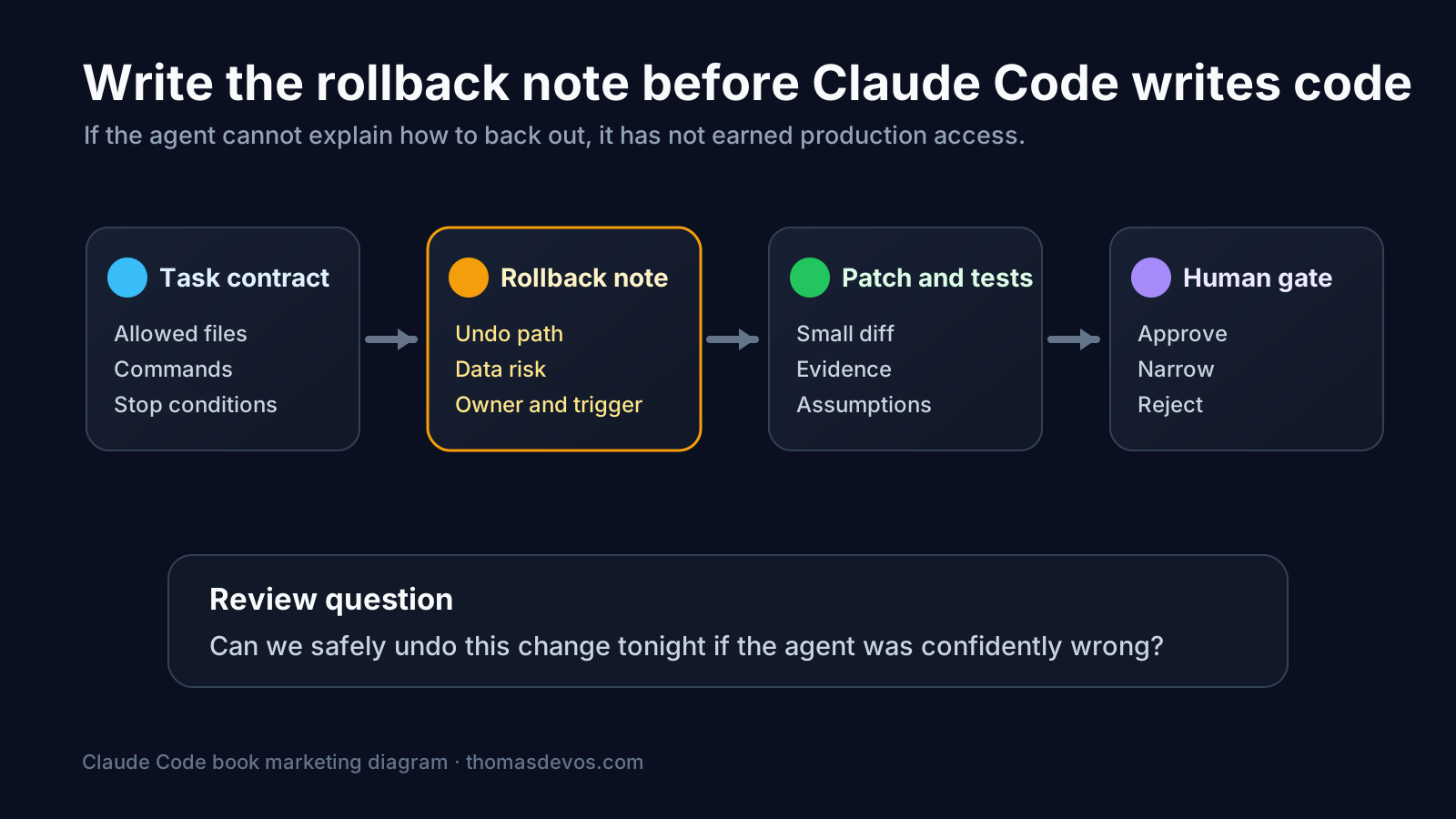
Claude Code needs a rollback note before code
Claude Code can get from instruction to patch so quickly that the rollback conversation arrives too late.
The agent has already changed files. The tests look green. The summary is tidy. Everyone wants to keep moving. Only then does someone ask the question that should have been asked at the start:
What do we do if this is wrong tonight?
That question changes the shape of the work. It forces the team to look past the happy path. It exposes whether the agent understood the operational boundary or only the local code change. It also gives the human reviewer a concrete reason to slow down before a clean-looking patch becomes a production incident.
For production-adjacent Claude Code work, I would make a simple rule: write the rollback note before the agent writes code.

A rollback note is not pessimism
Some engineers hear rollback and think release management. That is part of it, but the habit is useful much earlier.
A rollback note is a short explanation of how the team would undo or contain the proposed change if the agent is confidently wrong. It does not need to be a formal disaster plan. It does need to be specific enough that another engineer could act on it under pressure.
For a Claude Code task, I want something like this before the first edit:
Change: tighten invoice export filtering for EU accounts.
Rollback: revert the patch in billing/export/** and redeploy the export worker.
Data risk: exported files already generated during the bad window may need replay.
Trigger: error rate above normal, missing rows in reconciliation, or customer report.
Owner: billing on-call decides whether to revert or pause the export job.
Stop before: migrations, payment-provider adapters, production data, or deploy config.
That note is small, but it does several useful things. It names the operational consequence. It separates code rollback from data repair. It gives the human reviewer something to challenge. Most importantly, it prevents Claude Code from treating the patch as the whole task.
I wrote earlier about Claude Code needing a flight recorder. Rollback-first prompting strengthens that habit because the reviewer is not only judging the diff. They are judging whether the run has an exit path.
The undo path changes the prompt
A rollback note often reveals that the original task is too wide.
If the undo path says “revert the patch”, the work may be narrow enough for a normal Claude Code run. If the undo path says “coordinate data migration rollback across three services”, the agent should not be wandering through the repo with a broad instruction and a hopeful test command.
That is the value of asking early. The rollback note turns vague confidence into a scope decision.
A weak prompt says:
Fix the customer sync issue and update the tests.
A production-ready prompt is closer to:
Investigate customer sync failures for EU accounts.
Allowed reads: sync worker, sync tests, ticket PAY-4317, and recent error examples pasted below.
Allowed edits: sync worker and sync tests only.
Rollback note required before edits: how to revert the worker change and what data may need replay.
Stop before: schema changes, queue configuration, production data, or write-capable MCP tools.
Evidence required: failing test before fix, passing targeted tests after fix, assumptions, and residual risk.
The second prompt may feel slower. It is actually faster at finding the real risk. Claude Code can still do useful work, but now it has to work inside a contract that includes recovery.
That matters because agents are good at local completion. They are not automatically good at operational consequence. A patch can be correct in the narrow test case and still create a bad failure mode in production. The rollback note is where that difference becomes visible.
Ask Claude Code what would make rollback unsafe
The best rollback notes include an uncomfortable line:
Rollback may be unsafe if...
That line pulls hidden coupling into the open. Maybe the patch changes data shape. Maybe it writes to a queue that cannot be replayed cleanly. Maybe the external system has side effects. Maybe the MCP tool can update something outside the repository. Maybe the deploy path is shared with another service.
If Claude Code cannot name what would make rollback unsafe, the team should not treat that as reassuring. It may mean the task is simple. It may also mean the agent has not inspected the right boundary yet.
A useful answer sounds concrete:
Rollback may be unsafe if the worker has already emitted corrected export files,
because downstream reconciliation may see duplicate invoice rows. I will not change
export file naming or queue behaviour in this task. If either becomes necessary,
I will stop and ask for a separate approval.
That is the kind of note a reviewer can use. It says what the agent will not touch. It names a bad outcome. It creates a stop rule.
This pairs well with permission discipline. In Claude Code permissions need expiry dates, I argued that temporary access should close when the task ends. Rollback-first work adds another condition: if the rollback story changes, the permission story must be reviewed too.
Green tests do not prove reversibility
A common trap is treating tests as the rollback plan.
Tests are evidence. They are not an undo path. A test can prove the new behaviour for a narrow case. It does not prove that the deployment can be backed out, that data can be repaired, or that an external write can be reversed.
For Claude Code, this distinction matters because the agent may over-index on what it can run locally. It can create a failing test, fix the code, run the suite, and produce a confident summary. That is valuable. It is also incomplete for production-adjacent changes.
The review packet should include both:
Evidence:
- failing test added for duplicate EU invoice rows
- targeted billing export tests pass
- lint passes for billing package

Rollback:
- revert billing/export/** patch
- redeploy export worker
- replay affected export window if reconciliation detects duplicates
- billing on-call owns the revert decision
Now the reviewer can ask better questions. Did the agent touch anything that makes revert harder? Did it change file naming, schema, queue semantics, or an MCP-backed configuration? Did the rollback note still match the final patch?
That last question is important. The rollback note should be written before the code, then checked after the code. If the patch grew, the rollback note must change or the run should stop.
Make rollback part of the human gate
A human approval gate should not only ask whether the code looks reasonable. It should ask whether the team is willing to own the failure mode.
Before merge, the reviewer should be able to answer:
What changed?
What evidence did Claude Code produce?
What did it assume?
What would make this fail in production?
How do we undo or contain it?
Who decides if we need to roll back?
If those answers are missing, the review is not ready. That does not mean the agent failed. It means the workflow caught a gap before production did.
This is the same operating instinct I trust from years of financial-services engineering. Speed is useful, but only when the control path keeps up. The goal is not to make Claude Code timid. The goal is to make the team brave for the right reasons.
A starting prompt you can use
For the next production-adjacent Claude Code task, add this block before any implementation request:
Before editing files, write a rollback note.
Include: undo path, data risk, operational trigger, owner, and what would make rollback unsafe.
If the rollback note requires touching systems outside the current task scope, stop and ask for a narrower task contract.
After the patch, verify whether the rollback note still matches the final change.
That one block changes the conversation. Claude Code is no longer only trying to finish the task. It is also trying to keep the task reversible.
The free Claude Code production checklist includes prompts for rollback, permissions, MCP blast radius, review packets, evals, and observability.
For the full operating model, I wrote the Claude Code book for engineers and teams moving from impressive demos to controlled production use. The landing page routes readers to the Amazon Kindle edition as the primary purchase option.
Start with the free production checklist, then get the Claude Code book for the practical operating model: permissions, MCP, evals, observability, review gates, and rollback.