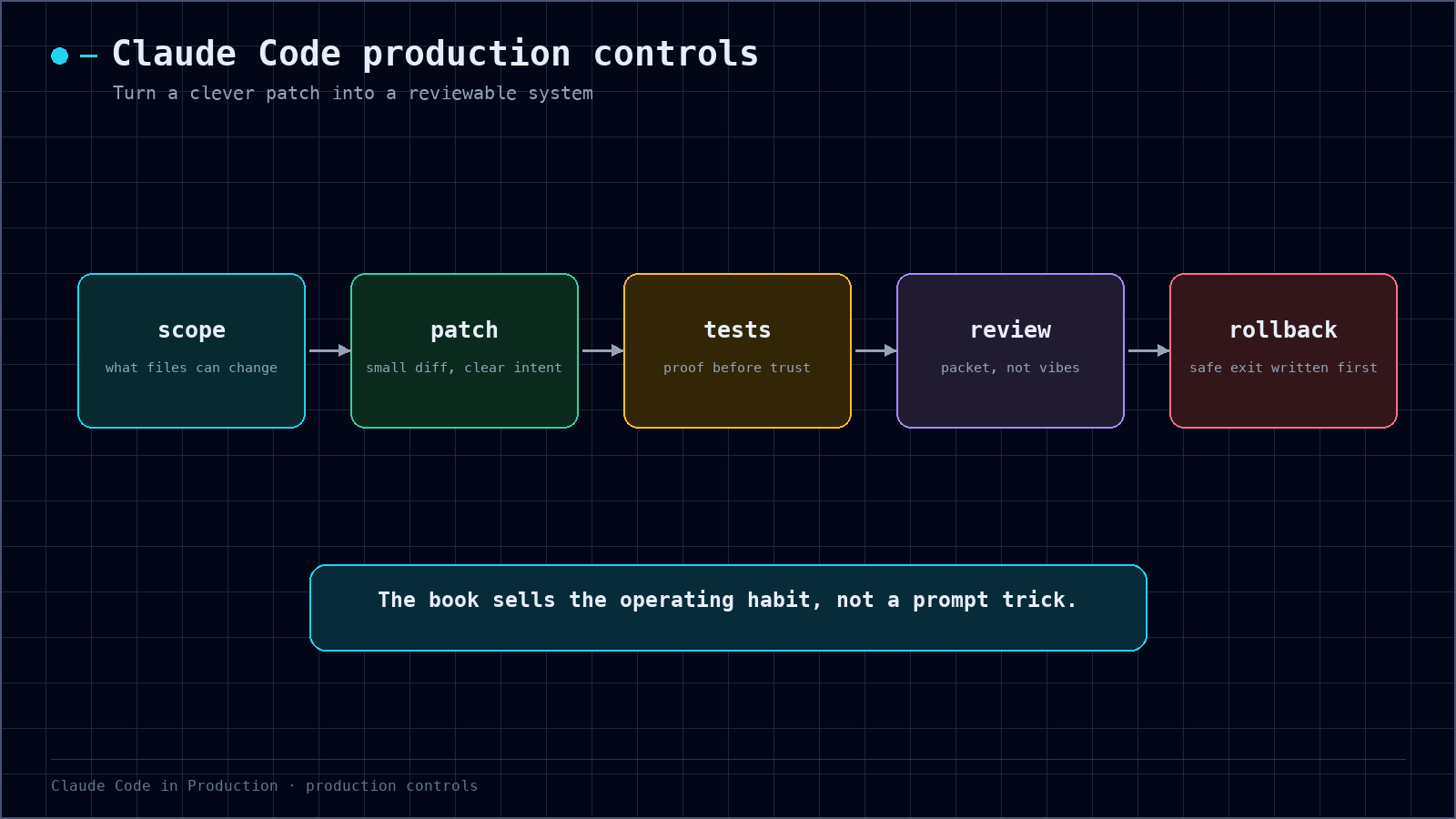
Do not merge Claude Code work without a review packet
A clean diff is not enough.
That is uncomfortable, because the diff is the thing engineers are trained to inspect. We look at changed files, test output, naming, edge cases, and whether the patch fits the existing shape of the codebase.
With Claude Code, the diff still matters. It just stops being the whole story.
The reviewer also needs the run record. What was the task contract? Which files did the agent read before making the change? Which commands did it run? What failed the first time? Did it edit outside the planned scope? Did it ask for extra permission? Which tests passed because they covered the risk, and which tests passed because they never touched it?
If the reviewer cannot answer those questions, the merge is based on trust in the final artifact rather than evidence from the run.
That is a weak operating model for production work.

This is the problem behind Claude Code: Building Production Agents That Actually Scale. The book is about the delivery loop around Claude Code: task contracts, bounded tools, eval evidence, run records, review packets, rollback notes, and human approval. If your agents also call enterprise tools, retrieve internal data, or act inside business workflows, pair it with Securing Enterprise AI Agents. The Enterprise AI Agents in Production bundle gives teams both sides of the same operating model.
The diff is only the visible artifact
A Claude Code patch can be tidy and still be hard to approve.
The changed files show the final state. They do not show the path the agent took to get there. That path matters when the agent read half the repository, ran commands that touched local state, changed a file outside the original plan, or found a shortcut the prompt did not describe.
This is not a reason to distrust every agent run. It is a reason to review the work at the right level. For a small documentation edit, the diff may be enough. For production code, data access, infrastructure, security policy, or release automation, the review needs evidence from the run.
The mistake is treating agent output like a normal patch when the process behind it was not normal. A human developer can explain what they tried, what they rejected, and why they believe the change is safe. Claude Code should hand over the same kind of evidence in a form the reviewer can scan quickly.
Define the packet before the run starts
The review packet should not be invented after the agent is finished. By then, the team is already tempted to accept the good looking diff and move on.
Write the packet shape before the run starts. Keep it short enough that people will use it.
Task contract:
Read scope:
Write scope:
Allowed commands:
Expected tests and evals:
Approval triggers:
Files changed:
Commands actually run:
Failed attempts or dead ends:
Known risks and assumptions:
Rollback note:
Human approval record:
The first half sets the boundary. The second half records what happened. The reviewer can then compare the plan with the run instead of guessing from the diff.
I like this because it turns the merge from a vibe check into an evidence check. Did the agent stay inside the task contract? Did it touch only the expected files? Did it run the right tests? Did anything require approval? Is the rollback path clear enough to use under pressure?
Those are answerable questions.
Capture failed attempts too
A good review packet includes the awkward parts.
If Claude Code tried a command that failed, record it. If it started down a wrong path and corrected course, record it. If it asked for wider access and the human said no, record it. If a test passed only after the agent changed the test, call that out clearly.
Failed or denied actions are not embarrassing. They are useful evidence. They show where the boundary held, where the task was underspecified, and where the reviewer should look harder.
This is the same reason security teams care about denied tool calls in enterprise agents. A denied MCP method or blocked data read may be the best proof that the control is real. That is the bridge to Securing Enterprise AI Agents: tool use needs a receipt along with the final answer.
Make rollback part of the merge standard
The rollback note is the part I do not want skipped.
If the patch breaks production behavior, the reviewer should not have to reconstruct the safe exit path during an incident. The exit path should be written while the context is still warm.
A useful rollback note says what to revert, what state to restore, what signal would trigger rollback, and who approves it. For a code change, that may be a commit revert and a feature flag. For a data or workflow change, it may require a repair script, a queue replay, or a manual check by the service owner.
Do not let the agent hand you a patch without a way back.
This is where Claude Code can become safer than a rushed human workflow. The agent can be told to produce the rollback note every time. The reviewer can reject the handover when the rollback note is missing or vague. The habit is simple, and it catches a surprising amount of risk.
Slow the merge, not the whole workflow
This is not anti-speed.
Let Claude Code move quickly inside a clear boundary. Let it draft, patch, test, and summarize. That is where it earns its keep.
Slow down when the boundary changes, when evidence is missing, when tool access expands, or when rollback is unclear. That is where human review matters.
The standard I would use is blunt: no serious Claude Code patch merges without a review packet.
Not a long report. Not a governance theatre document. Just enough evidence for a reviewer to answer: what did we ask the agent to do, what did it do, what proof do we have, what risk remains, and how do we undo it?
Start with your next real run
Pick the next Claude Code task that touches production code, infrastructure, security controls, or a workflow your team would hate to break. Before the run starts, write the review packet fields. After the run, reject the merge until the packet is filled in.
If your team wants Claude Code inside a production review loop, read Claude Code: Building Production Agents That Actually Scale. Kindle readers can go straight to Amazon: get the Claude Code book on Amazon Kindle.
If your main gap is delegated authority, MCP tool governance, RAG boundaries, audit evidence, and policy gates, read Securing Enterprise AI Agents or get it directly on Leanpub.
If you own both the engineering review loop and the security control loop, get the Enterprise AI Agents in Production bundle. One book helps the agent hand over reviewable code. The other helps the organization prove what authority the agent used while doing the work.