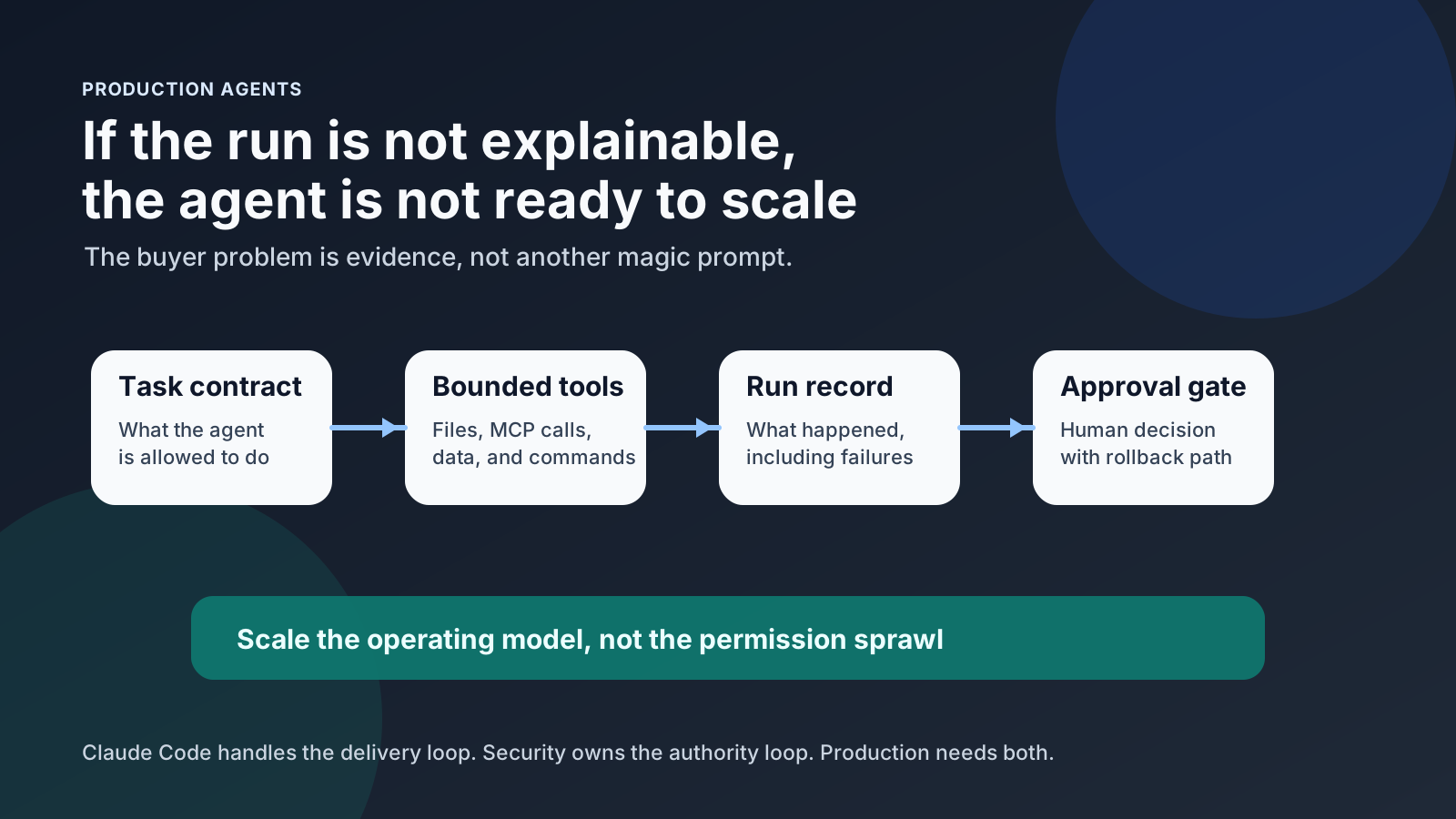
If the agent cannot explain the run, do not scale it
A good answer is not enough once the agent can act.
That sounds harsh until you watch how fast a useful demo turns into an informal production dependency. One engineer tries Claude Code on a real repo. A platform team connects an MCP server. A support workflow gets retrieval. Someone adds write access because the read-only version was too slow. Nobody thinks they are building a control plane. They are just removing friction.
Then the first uncomfortable question arrives: why was the agent allowed to do that?
If the team cannot answer from a record, it is not ready to scale the agent. It may still be useful. It may even be producing good work. But the operating model is missing the part that survives review, incident response, audit, and senior engineering scrutiny.

This is the thread that connects my two current books. Claude Code: Building Production Agents That Actually Scale is about the delivery loop around agentic coding: task contracts, scoped files, evals, review packets, rollback notes, and human approval. Securing Enterprise AI Agents is about the authority loop around enterprise agents: identity, tool governance, RAG boundaries, MCP controls, audit evidence, and policy gates. If your team owns both sides, the Enterprise AI Agents in Production bundle is the practical starting point.
The run has to answer for itself
The mistake is treating the final output as the whole artifact.
For Claude Code, that output is usually a diff. For an enterprise agent, it may be a ticket update, a retrieved answer, a workflow action, a data change, or a message sent to a customer. The output matters, but it does not tell you enough.
A production agent run should leave behind a short record that answers five questions:
What was the agent asked to do?
What data, files, tools, and commands could it use?
What did it actually read, change, call, or trigger?
What evidence says the result is safe enough?
How do we stop, reverse, or explain it if the run goes wrong?
That is not bureaucracy for its own sake. It is the minimum evidence a serious team needs before it gives software delegated authority.
Without that record, the team ends up arguing from memory. The developer remembers the prompt. The platform owner remembers the tool config. Security remembers an earlier risk review. The audit trail lives across Slack, local shell history, half-written PR notes, and hope.
Hope is a poor incident response system.
Claude Code makes this visible first
Claude Code is a useful forcing function because the risk is easy to see.
An agent that can read a repository, edit files, run shell commands, call MCP tools, and open a pull request is already inside the engineering control plane. It may be doing exactly what the developer wants. It still needs a boundary.
For serious code changes, I want the run record close to the PR. Not a long essay. A compact handover.
Task contract:
Read scope:
Write scope:
Allowed commands:
Permission changes during the run:
Tests and evals run:
Files changed:
Known risks:
Rollback note:
Human approval:
This changes the review from “does the diff look clean?” to “does the run make sense?” Those are different questions.
A clean diff can hide an over-broad read scope. Passing tests can hide weak coverage. A tidy refactor can hide a changed permission assumption. A confident summary can hide the fact that the agent tried three bad paths before landing on the fourth.
You want the awkward bits in the record. Failed commands, denied tool calls, widened scope, skipped tests, and assumptions are not noise. They are the places reviewers should look first.
Enterprise agents add an authority problem
Enterprise agents make the same issue more political.
The agent may not be changing code. It may be reading customer data, retrieving policy, opening tickets, summarizing calls, preparing decisions, routing exceptions, calling internal tools, or drafting messages. The output can look harmless while the authority behind it is messy.
That is where teams get caught. They review the answer quality and miss the permission shape.
The useful question is not “is this agent smart enough?” The useful question is: “what authority did we give this agent, under which identity, for which job, with which evidence, until when?”
If the answer is vague, the agent is not governed. It is merely trusted.
For enterprise work, the evidence needs to live above the individual run as well as inside it. You need named owners, approved tools, allowed data sources, approval triggers, retention rules, incident paths, expiry dates, and revocation. This is the part many pilots skip because the demo works better without friction.
The demo is allowed to be light. Production is not.
One operating test before you scale
Before expanding an agent rollout, I would use a simple test.
Pick one agent workflow that touches real code, real data, real tools, or a real business process. Ask a senior engineer, security lead, or incident responder to answer this in one minute:
Why was the agent allowed to do what it just did?
They have to answer from the system of record, not from the person who configured it.
If they can answer, you have the start of an operating model. If they cannot, you have a useful prototype with a missing control layer.
The fix is not to slow every agent run to a crawl. The fix is to make the boundary and the evidence normal. Small task contract. Clear tool scope. Run record. Evals or tests that match the risk. Human gates where authority changes. Rollback note before merge or release. Reviewable logs after the fact.
That is the pattern I would rather see teams buy into: agents that move quickly inside a boundary, and stop when the boundary changes.
Buy the books if this is the problem in front of you
If your immediate problem is Claude Code in real repositories, start with Claude Code: Building Production Agents That Actually Scale. Kindle readers can go straight to Amazon: get the Claude Code book on Amazon Kindle.
If your immediate problem is enterprise agent authority, identity, MCP security, RAG governance, audit trails, and policy gates, read Securing Enterprise AI Agents or get it directly on Leanpub.
If you own both the delivery loop and the authority loop, get the Enterprise AI Agents in Production bundle. One book helps teams make Claude Code useful without turning review into theatre. The other helps the organization prove the agent’s authority was deliberate, bounded, and reversible.