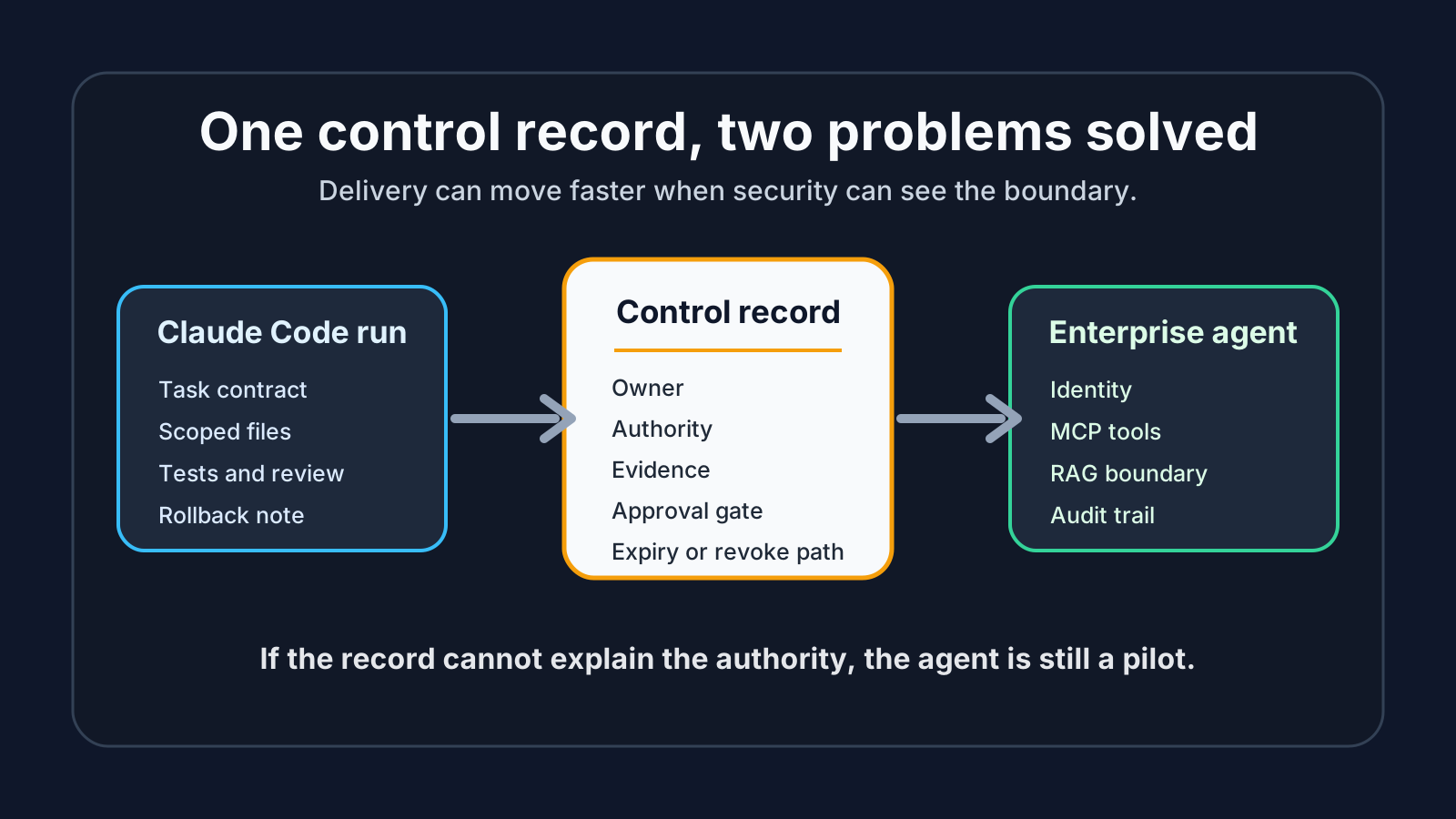
The control record is the bridge
Most teams talk about Claude Code and enterprise AI agent security as separate problems.
They are not separate for long.
A coding agent that can read a repo, edit files, run commands, and call MCP tools is already part of the engineering control plane. An enterprise agent that can retrieve internal knowledge, draft decisions, open tickets, update workflow tools, or touch customer context is already part of the business control plane. The vocabulary changes. The operating problem does not.
The agent needs a boundary. The team needs evidence. Someone has to answer why the agent was allowed to do what it just did.

That is the reason I keep writing about the same artifact from two angles. Claude Code: Building Production Agents That Actually Scale is about making agentic coding reviewable: task contracts, scoped files, tests, review packets, rollback notes, and human gates. Securing Enterprise AI Agents is about making delegated authority governable: identity, MCP security, RAG boundaries, policy gates, audit evidence, and revocation. If you own both sides, the Enterprise AI Agents in Production bundle is the shortest route.
The missing artifact is boring on purpose
A control record does not need to be fancy. It needs to be close enough to the work that people will actually fill it in.
For a Claude Code run, the record might live in the pull request, the ticket, or the run log:
Task:
Read scope:
Write scope:
Allowed commands and tools:
Files changed:
Tests or evals run:
Permission changes:
Human approval:
Rollback note:
For an enterprise agent, the same idea moves up one level:
Agent owner:
Business process:
Runtime identity:
Data sources:
MCP tools and methods:
Allowed actions:
Approval gates:
Denied actions logged:
Audit retention:
Revocation owner:
Review date:
Different fields, same habit. Before the agent acts, define the box. After the agent acts, keep the evidence.
This is where a lot of teams get uncomfortable. The record looks too small to matter. It feels like something a careful team can add later. But later is when the agent has users, integrations, expectations, and an informal mythology about how safe it is.
Add the record while the agent is still small. It is cheaper then.
Claude Code teaches the habit in public
Claude Code is a useful training ground because the failure modes are visible.
If the agent edits the wrong file, runs the wrong command, skips the relevant test, or widens the task without asking, the reviewer can see the damage. Sometimes the damage is obvious. Sometimes it hides inside a clean diff and a confident summary.
That is why I do not want the review packet to only say “implemented X”. I want the packet to show the run shape.
What was the agent allowed to read? What was it allowed to change? Which command proved the change? What did it try that failed? Did it ask for more permission? If the merge is bad, how do we back out?
Those questions sound heavy until they become a small template. Then they become normal engineering hygiene.
I have spent enough time around financial systems and production support to distrust stories that only work when nothing breaks. The useful control is the one an incident responder can read at 02:00 without asking five people what happened.
Enterprise agents need the same muscle
Enterprise agents make the same problem less visible and more political.
A retrieved answer can look harmless while the data boundary is wrong. A ticket update can look helpful while the agent identity is shared across too many workflows. An MCP tool can look like a convenience until one method quietly becomes a write path. A RAG pipeline can look safe because the answer is fluent, even though the agent should never have seen the source material.
Security teams should not wait for the rollout deck to ask about this. They should ask for the control record before the agent gets another tool, another data source, or another department.
The question is simple:
Can we prove the agent had the right authority for this job?
If the answer is yes, the team can move faster with less theatre. If the answer is no, the agent may still be useful, but it is still a pilot. Calling it production does not make it production.
The bridge is one operating model
The best teams will not run a fast Claude Code program over here and a separate agent security program over there. They will connect them.
The same operating model should say:
- how a task is scoped
- how tools and MCP methods are granted
- how the run is recorded
- when a human must approve
- what evidence counts as enough
- how rollback and revocation work
That is the bridge. It lets engineering keep the speed that made agents attractive in the first place, while giving security and risk something better than vibes.
It also makes the buying decision clearer. If your pain is mostly inside the repo, buy the Claude Code book. If your pain is mostly around identity, tool authority, RAG, MCP, and audit, buy the security book. If the same team is dealing with both, buy the bundle and use one language for the whole rollout.
Buy the books if this is your rollout problem
If your team is trying to make Claude Code safe enough for real repositories, start with Claude Code: Building Production Agents That Actually Scale. Kindle readers can buy it here: Claude Code on Amazon Kindle.
If your team is trying to secure enterprise AI agents before delegated authority spreads, read Securing Enterprise AI Agents or get it on Leanpub.
If you own both the delivery loop and the security model, get the Enterprise AI Agents in Production bundle. One control record is not the whole operating model, but it is the place I would start.