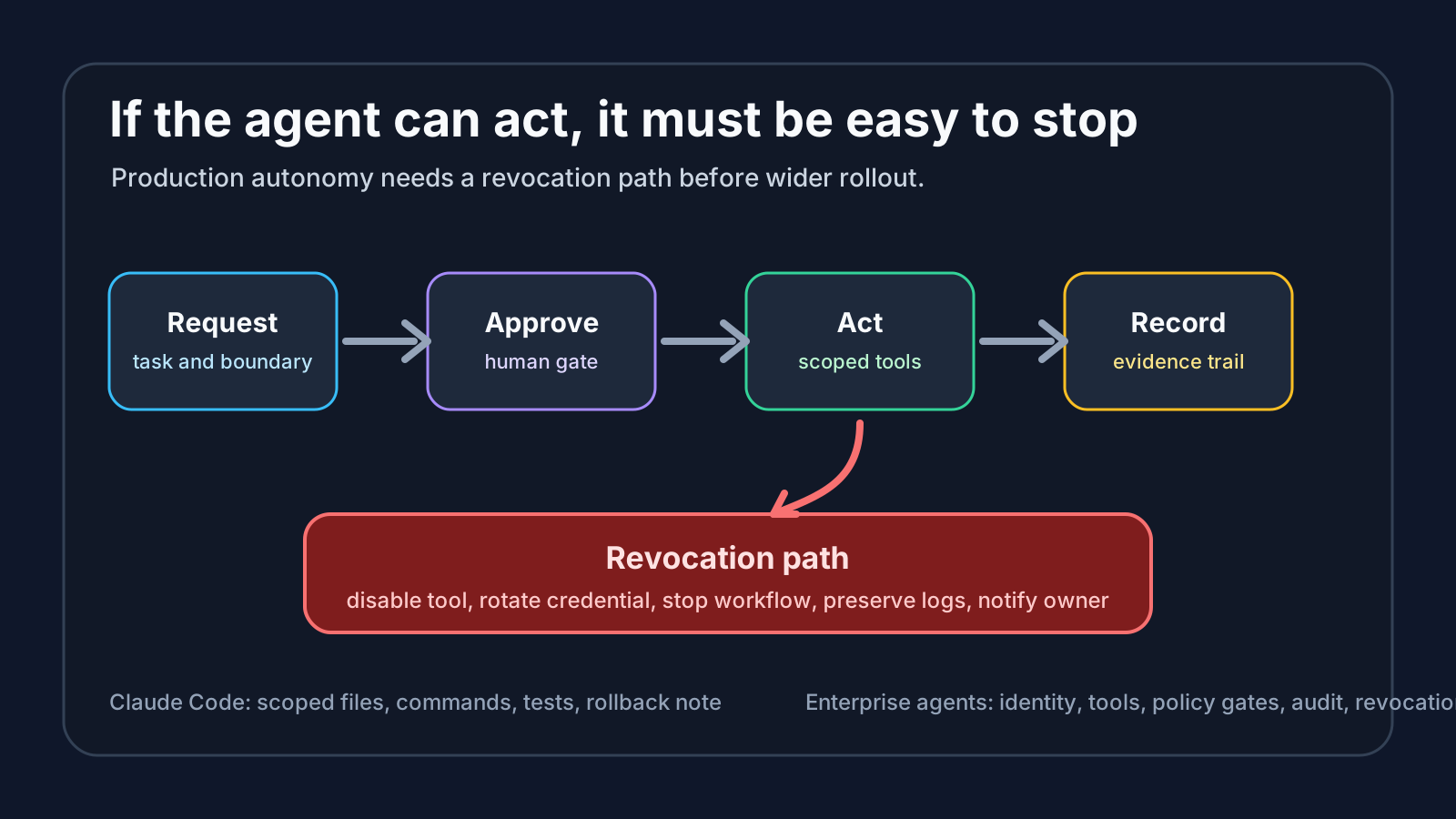
If the agent can act, it must be easy to stop
The awkward question for any production agent is not “can it do the task?”
The awkward question is “how do we stop it when the task changes shape?”
That matters for Claude Code. It matters even more for enterprise agents. A coding agent that can edit files, run commands, call MCP tools, or open pull requests is already operating inside your engineering control plane. A business agent that can retrieve internal data, update tickets, draft customer responses, or trigger workflows is operating inside your business control plane.
If either one gets more authority, the team needs a revocation path before the happy path goes live.

This is the practical reason I keep connecting my two books. Claude Code: Building Production Agents That Actually Scale is about making agentic coding safe enough for real repositories: task contracts, scoped files, tests, review packets, rollback notes, and human approval. Securing Enterprise AI Agents is about identity, tool authority, MCP controls, RAG boundaries, policy gates, audit evidence, and revocation. If your team owns both sides, the Enterprise AI Agents in Production bundle gives you one operating model instead of two separate debates.
A stop path is part of the design
Teams often treat revocation as an emergency procedure. Someone will figure it out if the agent misbehaves.
That is too late.
By the time the agent is in a real workflow, people have built habits around it. The integration has owners. The token has permissions. The MCP server has methods. The RAG source has data boundaries. The pull request path has expectations. If nobody wrote down how to remove authority, stopping the agent becomes a meeting instead of an action.
For a production agent, I want the stop path in the same record as the launch path:
Agent or workflow:
Authority granted:
Owner:
Tools and MCP methods:
Data sources:
Approval gate:
Telemetry required:
How to disable:
How to rotate credentials:
Logs to preserve:
Who gets notified:
Return-to-service rule:
That looks like operations paperwork because it is operations paperwork. The point is not ceremony. The point is being able to act calmly when the agent crosses a line.
Claude Code teaches the habit at repo scale
Claude Code makes revocation concrete.
If the agent is allowed to edit one directory, how do you remove that permission? If it can run tests, which commands are allowed and which commands are denied? If it asks for shell access, who approves it? If it touches deployment scripts, what proof does the reviewer need before merge? If the diff is bad, where is the rollback note?
A safe Claude Code workflow should make those answers boring:
Read scope: app/orders/**
Write scope: app/orders/** and tests/orders/**
Denied scope: auth/**, migrations/**, deploy/**
Allowed commands: unit tests for orders
Approval needed: any command that writes outside the workspace
Rollback: revert PR and restore previous config
This is not about distrusting the tool. It is about refusing to confuse a good run with a safe operating model. Good runs happen. Weird runs happen too. The workflow needs to handle both.
I have spent enough time around production support and financial-services controls to know the bad day will not respect the demo script. The useful question is simple: if this agent edits the wrong thing, can we stop it, explain it, and roll back without guessing?
Enterprise agents need revocation even more
Enterprise agents hide the same problem behind softer language.
“Better retrieval” might mean the agent can now see a data source with a different classification. “Workflow automation” might mean the agent can update a system of record. “MCP integration” might mean one method can read harmless context while another can change state. “Shared service account” might mean the audit trail is weak before the first incident.
The control cannot stop at an approval screen. Approval matters, but revocation matters just as much.
Before an enterprise agent gets wider access, ask:
Can we disable this specific tool without disabling the whole platform?
Can we revoke one data source without breaking unrelated workflows?
Can we rotate the agent credential quickly?
Can we see which actions happened under this authority?
Can we tell users what changed?
Can we prove the agent stopped acting after revocation?
If the answer is no, the agent may still be useful, but it is not ready for broad autonomy.
The buying signal is pain around authority
If your team is asking these questions, you are probably past the toy phase.
The buyer pain is no longer “how do we prompt the model?” It is “how do we let useful agents work without handing them vague, permanent authority?” That is an engineering problem and a security problem at the same time.
If your pain starts in the repo, buy Claude Code: Building Production Agents That Actually Scale. Kindle readers can buy it here: Claude Code on Amazon Kindle.
If your pain starts with enterprise rollout, delegated authority, MCP tools, RAG, audit, and policy gates, read Securing Enterprise AI Agents or get it on Leanpub.
If the same group owns both coding-agent delivery and enterprise-agent security, get the Enterprise AI Agents in Production bundle. A revocation path will not make agents risk free. It will make the risk visible enough to manage.