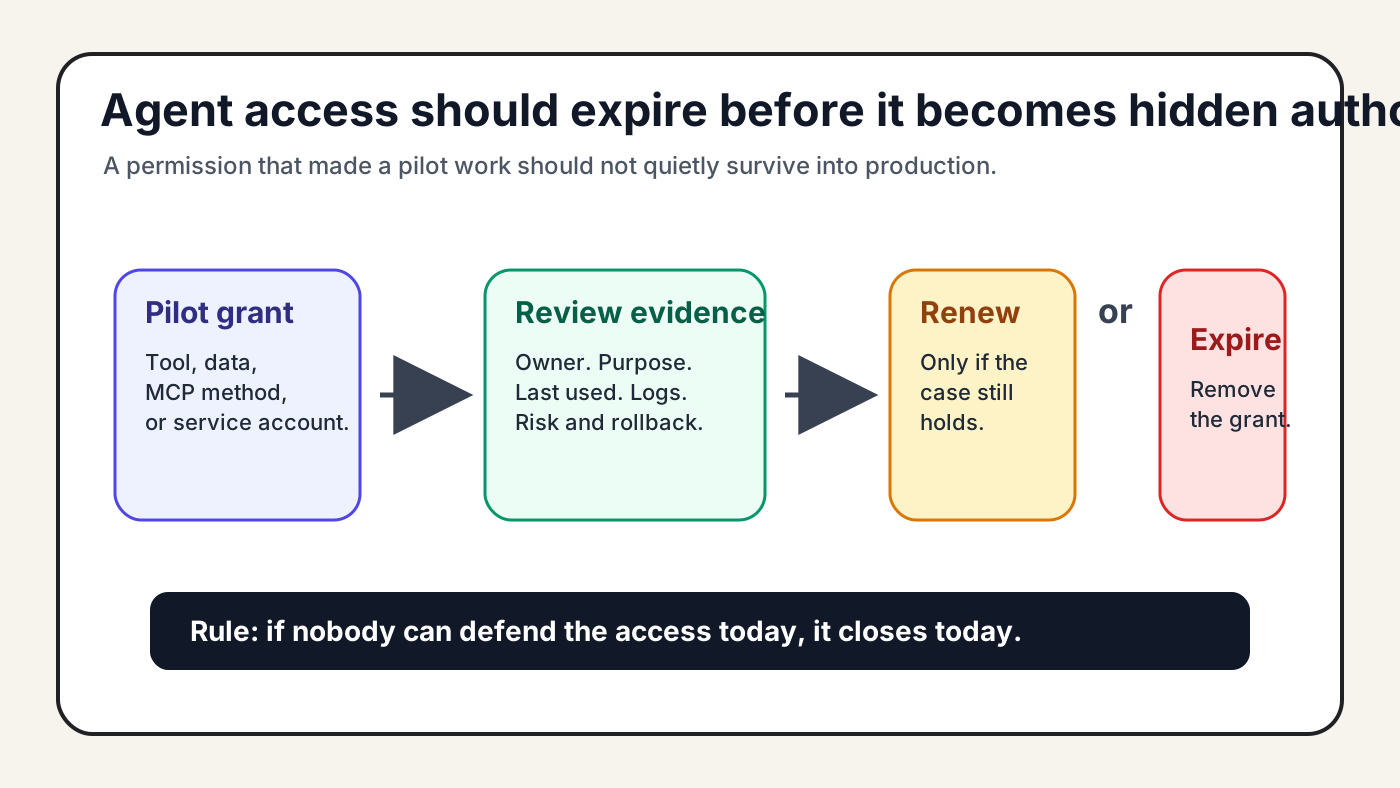
AI agent access should expire before it becomes hidden authority
The risky permission is often the one nobody remembers granting.
A pilot needed an MCP tool. A coding agent needed one wider directory. A service account got an extra scope so the demo could reach a system. A retrieval index was opened because the agent needed better answers.
All of that can be reasonable during a controlled experiment. The mistake is letting those permissions live forever because the pilot worked.
That is how agent access becomes hidden authority.

This is where my two books meet. Claude Code: Building Production Agents That Actually Scale is about the delivery loop around coding agents: task contracts, scoped files, permission budgets, tests, review packets, rollback, and human approval. Securing Enterprise AI Agents is about the authority loop around agents in the enterprise: identity, MCP methods, data boundaries, policy gates, audit evidence, and revocation.
If your team owns both sides, the Enterprise AI Agents in Production bundle gives you one operating model for useful agent work and controlled agent authority.
Access should be a lease, not a grant
Human access reviews are annoying, but the idea is sound. People change roles. Systems change. Projects end. Access that was correct last quarter can be wrong today.
Agents need the same habit, and in some cases they need it sooner. An agent does not only read a dashboard. It can call tools, fetch internal data, open tickets, trigger workflows, edit files, run commands, or pass information into another system. If the access is wrong, the blast radius is not theoretical.
I would treat every agent permission as a temporary lease.
Agent or workflow:
Owner:
Business purpose:
Tool, data source, MCP method, or command:
Systems touched:
Data scope:
Approval required:
Logs or evidence location:
Rollback or removal path:
Expiry date:
Renewal evidence required:
The point is not paperwork. The point is to stop permissions becoming the default just because nobody removed them.
Renewal should require evidence
A renewal should answer a simple question: does this agent still need this authority?
Not did it need it during the pilot. Not does the workflow still feel useful. Does it still need this exact access today?
Useful evidence is plain:
Who owns the workflow now?
When was the permission last used?
Which systems did the agent touch?
Which data was available to it?
Did the run hit any approval gates?
Were there incidents, near misses, or manual corrections?
Can the team remove the access without breaking production work?
What narrower permission would be enough?
If the team cannot answer those questions, remove the access or downgrade it. The agent can ask again when a real task needs it.
That sounds strict until you look at what happens without it. A temporary MCP method becomes part of the agent’s normal tool belt. A one-off data scope becomes a permanent retrieval boundary. A coding agent that once needed deployment config keeps seeing deployment config on ordinary refactors. Nobody made a fresh decision. The system just kept yesterday’s exception.
Claude Code has the same problem in miniature
Claude Code makes this easy to see because the permission surface is close to the work.
A task starts narrow. Then the agent asks for another folder. Then a command. Then a config file. Then a script that touches a system outside the original task. Each step may be defensible. The problem is when the widened boundary becomes normal.
For Claude Code, an expiry rule can be simple:
When the task ends, the extra permission ends.
When the run pauses, the extra permission closes.
When the task changes, the permission must be requested again.
When the review packet is incomplete, the permission is not renewed.
This is the operating discipline behind production agentic coding. The prompt matters, but the prompt is not enough. The team needs a loop that says what Claude Code may touch, what changed during the run, which evidence came back, and what access closed afterward.
A clean diff does not prove the agent had the right authority. Green tests do not prove the boundary was still safe. The review packet should make both visible.
Enterprise agents make the stakes bigger
The same pattern gets more expensive when the agent moves outside one repository.
Enterprise agents may use service accounts, retrieval indexes, workflow tools, CRM records, ticketing systems, document stores, payment data, customer data, or regulated records. They may call MCP servers that hide several downstream actions behind one neat method name.
That is where access expiry becomes an AgentSecOps control, not a nice extra.
A useful review asks:
Does the agent still have a named owner?
Does the business process still exist?
Is this MCP method still the narrowest safe method?
Is the retrieval scope still correct?
Are approval bypasses still justified?
Can audit reconstruct recent runs?
Can security revoke the permission quickly?
What breaks if this access expires today?
The best answer is sometimes renewal. Some agents really do need stable access to do useful work. Fine. Renew it with evidence and a new review date.
The worst answer is silence.
The sales pitch is the audit trail
For internal buyers, the audit trail is often more persuasive than the demo.
A demo proves the agent can do something useful. An access record proves the organization can own what the agent is allowed to do. That is a different kind of confidence, and it matters when the workflow touches production, customers, finance, security, or regulated data.
If you are trying to get agent work approved, do not only show the clever output. Show the control loop:
Small task contract.
Named owner.
Scoped access.
Expiry date.
Evidence after the run.
Renewal or removal decision.
Rollback path.
That is a conversation a skeptical engineering leader, security reviewer, or auditor can work with.
It is also how teams avoid the ugly version of agent adoption: many useful experiments, no clear owner, too much lingering access, and a painful cleanup later.
Start with the book that matches the access problem
If your immediate problem is Claude Code in real repositories, start with Claude Code: Building Production Agents That Actually Scale. Kindle readers can buy it on Amazon here: Claude Code on Amazon Kindle. The book walks through task contracts, scoped autonomy, review packets, rollback-first prompting, observability, cost control, and approval gates.
If your problem is enterprise agent authority, read Securing Enterprise AI Agents or get the LeanPub edition here: Securing Enterprise AI Agents on LeanPub. It covers identity, MCP boundaries, data scope, policy gates, audit evidence, incident response, and access review.
If the same team owns both the coding-agent rollout and the enterprise control model, get the Enterprise AI Agents in Production bundle. One book helps you make agent delivery reviewable. The other helps you keep agent authority from drifting into a mess nobody wants to inherit.