Claude Code review packets beat clean diffs
A clean diff is not enough.
That is the trap with Claude Code in production work. The agent can produce a tidy patch, a confident summary, and a test run that looks respectable. The reviewer sees progress. The team wants to keep moving. The risk sits in the gap between what changed and what the reviewer can prove.
For small work, that may be fine. Rename a variable. Fix a typo. Update a README. Move on.
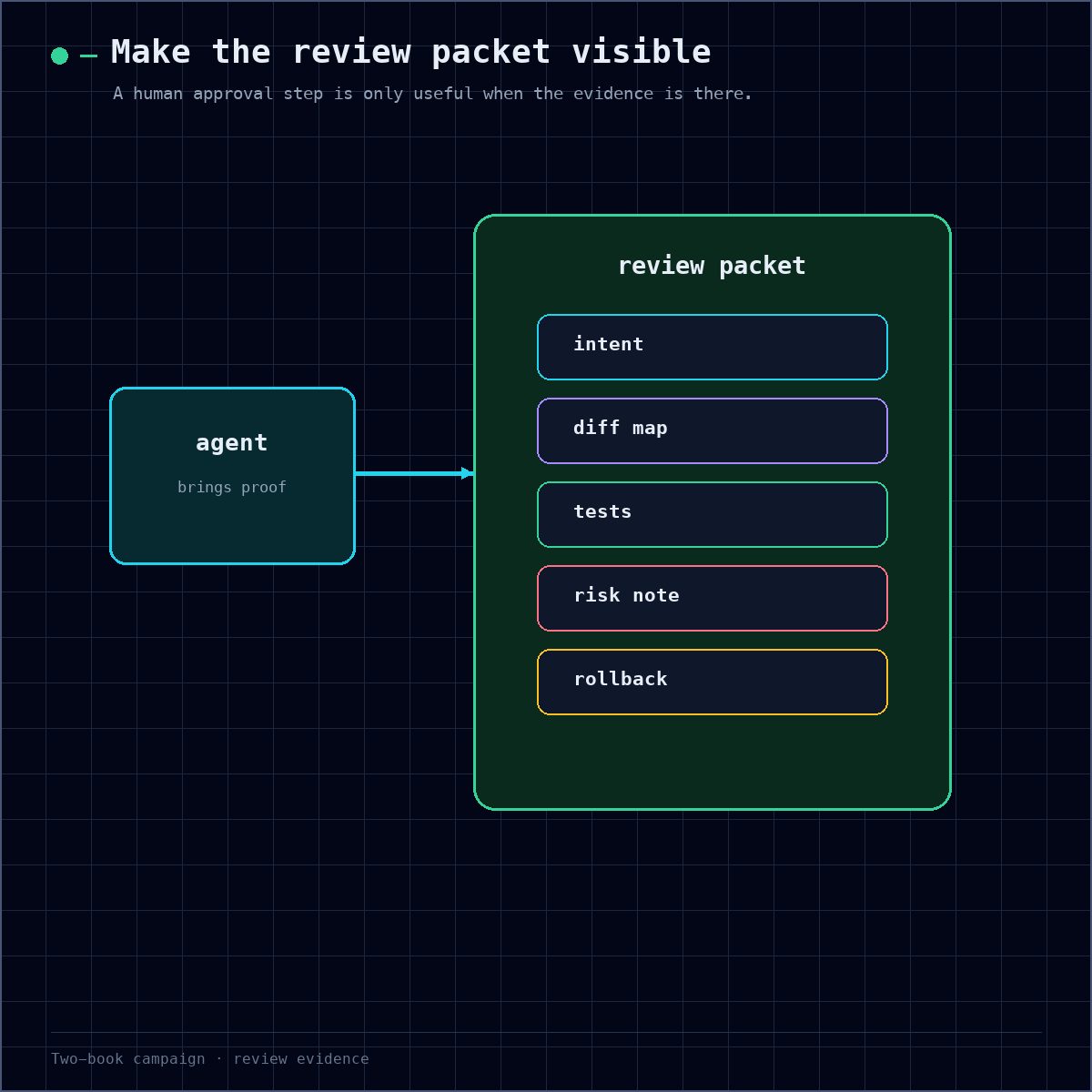
For production work, I want a review packet.

The diff is only one artifact
A diff tells you which lines changed. It does not tell you whether the agent stayed inside the task, whether it touched a risky edge, whether the test evidence covers the real failure mode, or whether a human can reverse the change quickly.
That matters near auth, billing, deployments, migrations, scheduled jobs, customer data, MCP tools, external APIs, and anything close to secrets. Same agent. Different blast radius. Different review bar.
The phrase I distrust in agent work is “looks good”.
Looks good compared with what? The requested scope? The permission boundary? The test evidence? The rollback plan? The production behavior?
A review packet forces that conversation before merge, while the details are still fresh.
What the packet should answer
I like a plain packet. No ceremony. No fake governance theatre. Just the facts a senior engineer would want before approving the change.
Task contract:
Files and directories in scope:
Tools, commands, or MCP servers allowed:
What stayed out of scope:
Summary of the diff:
Exact tests or checks run:
What those checks prove:
What was not tested:
Runtime, data, security, or customer risk left behind:
Rollback or disable path:
First files or lines for human review:
This changes the job. Claude Code does more than write code. It prepares evidence for a human decision.
That evidence matters because agent output often fails at the edges. The patch may work for the example path and still miss a permission boundary, a migration side effect, a stale cron job, a production flag, or an MCP method with too much reach.
The review packet gives the reviewer handles. It turns “looks good” into scope, evidence, gaps, recovery, and approval.
Ask for the contract before the edit
The packet is stronger when the agent states the contract before it starts changing files.
A useful prompt pattern is simple:
Before editing, restate the task contract.
List the files, tools, commands, and MCP servers in scope.
List what you will not touch.
If you need more scope, stop and ask.
After editing, return a review packet with the diff summary, exact tests run, gaps, residual risk, rollback path, and first files for human review.
Do not claim safety without evidence.
That prompt does not make the agent safe by itself. It gives the human a boundary to compare the run against.
If the agent changes the task, widens the file scope, calls a new tool, or touches a production-adjacent path, the packet should say so. Silence is the smell.
The same habit applies to enterprise agents
Claude Code makes the pattern easy to see because the work is close to the repository. Enterprise agents need the same habit, only wider.
An internal agent that reads documents, opens tickets, calls MCP servers, updates CRM records, or triggers workflows should leave a packet too. The fields change a little:
Business process:
Agent identity:
Data sources used:
Tools and MCP methods allowed:
Tools and actions denied:
Systems touched:
Approval points hit or bypassed:
Logs and audit trail:
Revocation owner:
Rollback or correction path:
This is where my two books meet. Claude Code: Building Production Agents That Actually Scale is about the delivery loop around coding agents: task contracts, scoped edits, tests, review packets, rollback, cost control, and human approval. Securing Enterprise AI Agents is about the authority loop around enterprise agents: identity, MCP boundaries, data scope, audit evidence, policy gates, and revocation.
If your team owns both sides, the Enterprise AI Agents in Production bundle gives you one operating model for useful agent work and controlled agent authority.
Make missing evidence a stop signal
A review packet is only useful if missing evidence changes the decision.
If the agent cannot say which tests ran, do not treat the change as tested. If it cannot name the rollback path, do not pretend recovery is covered. If it widened permissions during the run and the packet hides that fact, the review process is broken.
The strongest teams will not win because they let agents touch more code. They will win because they make agent work easier to inspect.
That is the practical shift. Prompt quality matters. Review quality matters more once the agent is in a real repo.
Start with the book that matches your pain
If your immediate problem is Claude Code in production repositories, start with Claude Code: Building Production Agents That Actually Scale. Kindle readers can buy it here: Claude Code on Amazon Kindle.
If your problem is agent authority, MCP security, RAG governance, audit evidence, approval gates, and regulatory pressure, read Securing Enterprise AI Agents or get the LeanPub edition here: Securing Enterprise AI Agents on LeanPub.
If your team owns both the coding-agent rollout and the enterprise control model, get the Enterprise AI Agents in Production bundle. One book helps you make agent delivery reviewable. The other helps you prove the agent had bounded authority while doing it.