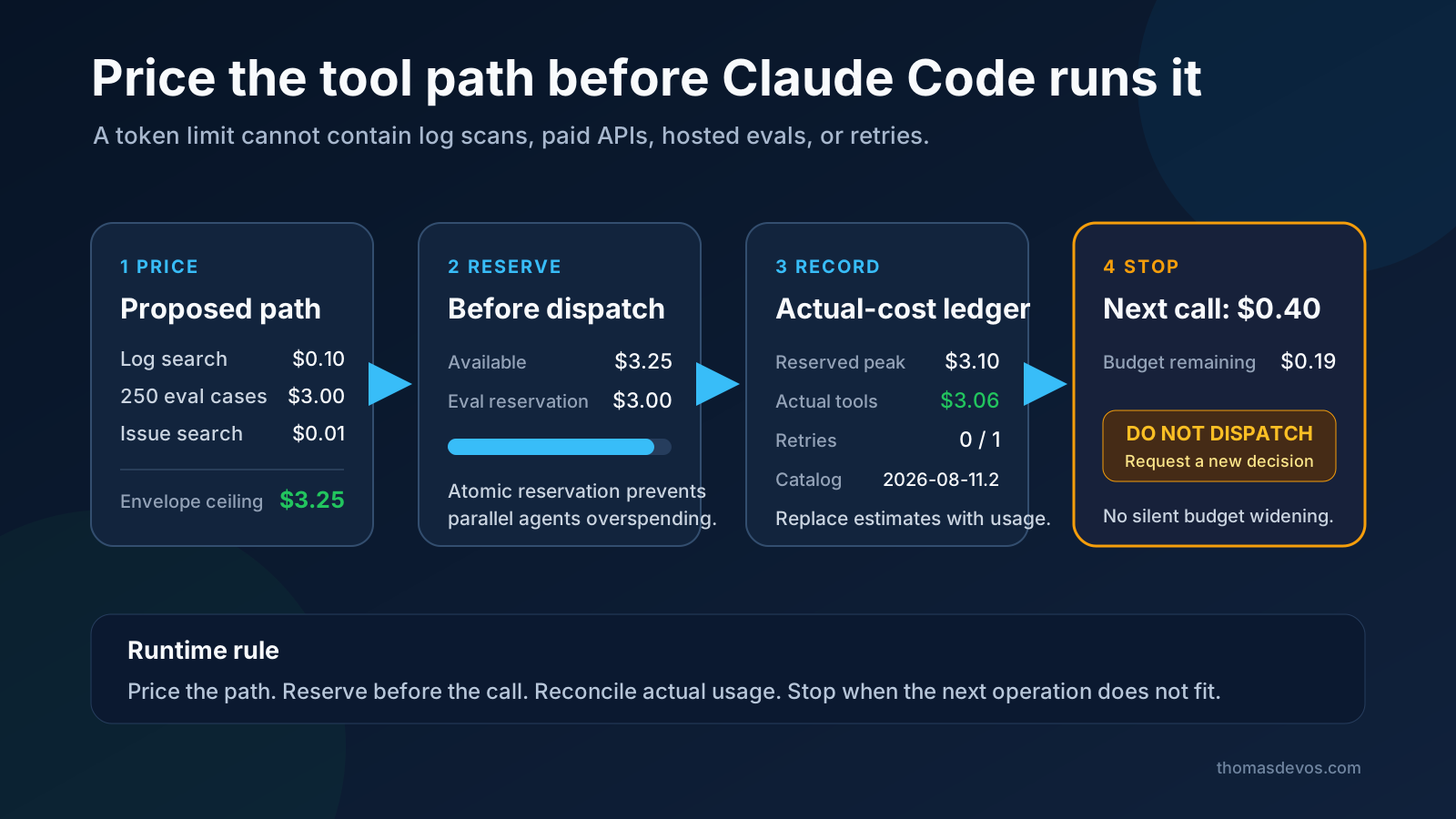
Claude Code is asked to investigate a checkout failure. The run reads the repository, searches production logs, queries an issue tracker, and launches an eval suite. The first eval finds a flaky fixture, so the agent retries twice with broader traces.
The model bill might still look small. The tool path does not.
log search:       3 queries x 40 GB scanned
eval runner:      3 runs x 250 cases
issue search:     6 requests
artifact storage: 750 traces
A token limit cannot contain those costs. It knows nothing about bytes scanned, paid API calls, hosted test minutes, or the human time needed to inspect 750 traces.
Before a production run starts, I want Claude Code to submit a cost envelope for the path it intends to use. The runtime should reserve that budget before each call and stop when the remaining envelope cannot cover the next operation.

price units, not tool names
“May query logs” is a permission. It is not a budget.
The same log tool might scan 50 MB for a narrow request or 500 GB for a wildcard. Price the unit that drives the bill:
cost_catalog:
  log.search:
    unit: gb_scanned
    price_usd: 0.005
  eval.run:
    unit: test_case
    price_usd: 0.012
  issue.search:
    unit: request
    price_usd: 0.003
  model.reason:
    unit: million_tokens
    price_usd: 18.00
Keep the catalog outside the prompt. The tool gateway or orchestration layer should own it, version it, and attach the applicable price to each decision. An agent should not be able to lower a price estimate by rewriting its own instructions.
Some costs do not have a clean dollar rate. Track them anyway. Wall-clock minutes, trace count, changed files, and expected review minutes can each have a ceiling. A run that stays below its provider bill but creates a two-hour review is not cheap.
This extends the permission budget pattern. Permission decides whether a capability is available. The cost envelope decides how much of that capability this run may consume.
require a preflight path
The agent does not need to predict every branch. It does need to expose the expensive route it currently expects:
cost_envelope:
  task_id: checkout-timeout-284
  run_id: cc-run-a18f
  catalog_version: 2026-08-11.2
  proposed_path:
    - tool: log.search
      calls: 2
      maximum_units_per_call: 10
      maximum_cost_usd: 0.10
    - tool: eval.run
      calls: 1
      maximum_units_per_call: 250
      maximum_cost_usd: 3.00
    - tool: issue.search
      calls: 3
      maximum_cost_usd: 0.01
  ceilings:
    external_tools_usd: 3.25
    model_usd: 1.50
    elapsed_minutes: 25
    eval_cases: 250
    retries: 1
    review_minutes_estimate: 20
  stop_if:
    - query scope requires production wildcard
    - eval fixture changes
    - retry lacks new evidence
A useful preflight states the maximum, not the average. The gateway can approve a smaller reservation at runtime, but the run should never rely on a best-case estimate to fit under the ceiling.
The stop conditions matter as much as the arithmetic. Changing an eval fixture can make a failure disappear while weakening the test. A production wildcard changes data exposure as well as cost. Neither belongs inside an automatic budget adjustment.
reserve cost before dispatch
Checking spend after a call returns is too late. The charge may already exist.
Before dispatch, reserve the call’s maximum expected cost:
available external budget: $3.25
reserved by eval.run:       $3.00
remaining:                  $0.25
next log.search maximum:    $0.40
 decision: stop before dispatch
Reservations also protect parallel runs. Without them, four subagents can each see the same remaining dollar and all spend it at once. The budget service should update reservations atomically, then replace the estimate with actual usage when the tool returns.
If a provider cannot expose usage before or after a call, use a conservative fixed price or keep the tool behind human approval. Unknown cost should not mean unlimited cost.
The same boundary should reject calls that exceed permission scope. Cost control is not a substitute for method-level MCP permissions. A cheap production write can still be the wrong write.
make every retry buy evidence
Retries multiply tool spend quietly. A three-dollar eval becomes nine dollars because the agent changed one line and tried again twice.
Record why the next attempt deserves budget:
retry_request:
  previous_attempt: 1
  failed_check: checkout-timeout-eval
  new_evidence: ev-trace-91
  changed_assumption: timeout begins after gateway handoff
  proposed_change: move deadline propagation into checkout client
  repeated_calls:
    - eval.run
  added_cost_usd: 3.00
  remaining_retry_budget: 0
“Try again” is not evidence. A different failure, a narrowed hypothesis, or a new observation may justify another attempt. If the run learned nothing, the cost loop should stop.
Do not let the agent fund a retry by shrinking another estimate after the fact. Budget changes need a fresh envelope and, above a team threshold, human approval.
keep an actual-cost ledger
The review packet should show proposed, reserved, and actual consumption by cost class:
cost_ledger:
  run_id: cc-run-a18f
  catalog_version: 2026-08-11.2
  external_tools:
    ceiling_usd: 3.25
    reserved_peak_usd: 3.10
    actual_usd: 3.06
  model:
    ceiling_usd: 1.50
    actual_usd: 0.74
  eval_cases:
    ceiling: 250
    actual: 250
  retries:
    ceiling: 1
    actual: 0
  stopped_calls:
    - tool: log.search
      reason: reservation_would_exceed_external_ceiling
  pricing_unknown: []
  decision: within_envelope
Save the catalog version and raw provider usage references with the ledger. Prices change. Reviewers need to know which rate produced the total, and operators need enough evidence to reconcile the invoice later.
This ledger also gives the team something useful to optimize. If log scans dominate, narrow the query tool. If eval retries dominate, improve failure classification. If review time dominates, improve the evidence linked to each action. Cost data should change the workflow, not merely decorate a dashboard.
My rule is straightforward: price the proposed path, reserve the next call, and record actual spend. When the next operation does not fit, Claude Code stops and asks for a new decision.
Claude Code: Building Production Agents That Actually Scale connects cost envelopes with MCP boundaries, retry controls, evals, traces, rollback, and review packets for production coding-agent work.