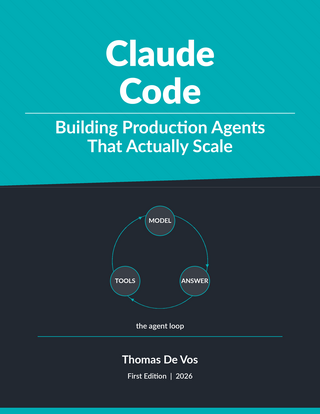
Claude Code book is live on Amazon Kindle
Claude Code: Building Production Agents That Actually Scale is now live on Amazon Kindle. Here is who it is for and why I wrote it.
Claude Code: Building Production Agents That Actually Scale is now live on Amazon Kindle. Here is who it is for and why I wrote it.

If a Claude Code agent can change production-shaped code, the prompt should say how to undo the work. Rollback is not paperwork after the diff. It is part of the task boundary.

Claude Code cost problems usually start before the model call: vague tasks, wide-open tools, repeated repo exploration, and no stop rule. Treat spend as a workflow bug, not just a pricing problem.

Production Claude Code evals should not begin with abstract benchmarks. Start with the agent runs that scared you, reduce them into replayable cases, and use them to tune permissions, prompts, tools, and review gates.

Claude Code permission modes can look safer than they are. The real production risk lives in tool scope: paths, network access, secrets, deploy files, and what reviewers actually approve.

If a Claude Code agent changes production code, the useful artifact is not the chat transcript. It is a flight recorder: intent, boundaries, commands, diffs, tests, approvals, and rollback notes.

A Claude Code demo is easy to love. You describe a feature, the agent edits files, runs commands, fixes its own mistakes, and suddenly the repository has moved. The first time you see it work, it feels like software engineering has skipped a generation. But the demo is not the hard part. The hard part is making that same capability safe enough, repeatable enough, and observable enough that you would trust it inside a real engineering workflow. That is where the actual product begins. ...

It was a Tuesday, the kind where the London drizzle seemed to seep into your bones, even if you were miles away in Basingstoke (my home town). I was tasked with a rather daunting project, or not really as you will find out: designing and deploying a real-time Sentiment Analysis product for a major telecommunications company, and, oh, they needed it yesterday. Or so it felt. Now, usually, this would mean weeks of planning, coding, debugging, and endless cups of tea. But this time, something was different. I decided to try something I’d been experimenting with – something I now call “Vibe Coding.” ...
Python is still the easiest place to experiment with AI. Java still earns its keep when AI has to live inside enterprise systems. The real question is where the AI application crosses from prototype into production risk.

AI agents are not just chatbots with a loop. For production teams, the useful definition is about delegated authority: what the system can see, decide, call, change, and prove afterward.