New Leanpub book
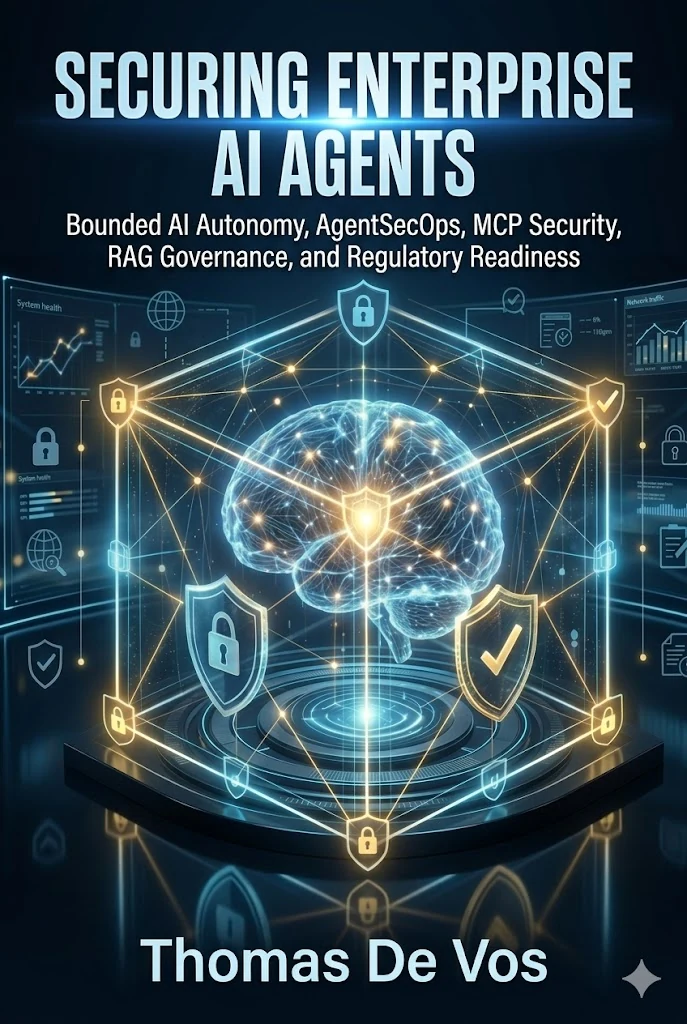
Secure enterprise AI agents before autonomy becomes liability.
Securing Enterprise AI Agents is for teams putting AI agents into serious environments: regulated workflows, customer data, internal tools, financial-services controls, and systems where "the model did it" is not an acceptable answer.
My position is simple: the enterprise future is not maximum autonomy. It is bounded autonomy with security, governance, and evidence built into the operating model.
The book covers AgentSecOps, MCP security, RAG governance, identity, evals, policy, approval flows, audit trails, and regulatory readiness for agentic systems that have to survive real scrutiny.
Who it is for
This book is written for CISOs, CIOs, CTOs, enterprise architects, security architects, AI platform teams, auditors, risk owners, and product teams who need agents to do useful work without giving them a blank cheque.
It is especially relevant if your agents can use tools, call APIs, retrieve internal knowledge, touch customer workflows, open tickets, write code, change data, or influence regulated decisions.
What the book covers
- why agentic AI changes the risk model from “answer quality” to delegated authority
- bounded AI autonomy as the default pattern for enterprise agents
- AgentSecOps as the operating model for inventory, ownership, testing, monitoring, and incident response
- MCP security and tool governance as capability design, not plugin convenience
- RAG governance across source inventory, access-aware retrieval, freshness, lineage, and evidence
- identity, delegated authority, approval workflows, audit trails, and regulatory readiness
- evals, red-team scenarios, evidence stores, and release gates for agentic systems
Where Claude Code fits
Claude Code is one concrete place where agent security stops being theoretical. An agent with repo access, tools, MCP servers, shell commands, and CI influence is already operating inside the control plane.
If your team is adopting Claude Code, the security question is not later. It belongs in the workflow design.
Read the Claude Code field guide or get both books as a bundle.
Why now
The market is moving quickly from chat interfaces to systems that can act. That is the dangerous step. A chatbot can be wrong. An agent can be wrong with credentials, tools, memory, workflow authority, and speed.
Regulated teams cannot wait until auditors ask awkward questions. They need an operating model before the first high-trust agent quietly becomes part of production.